
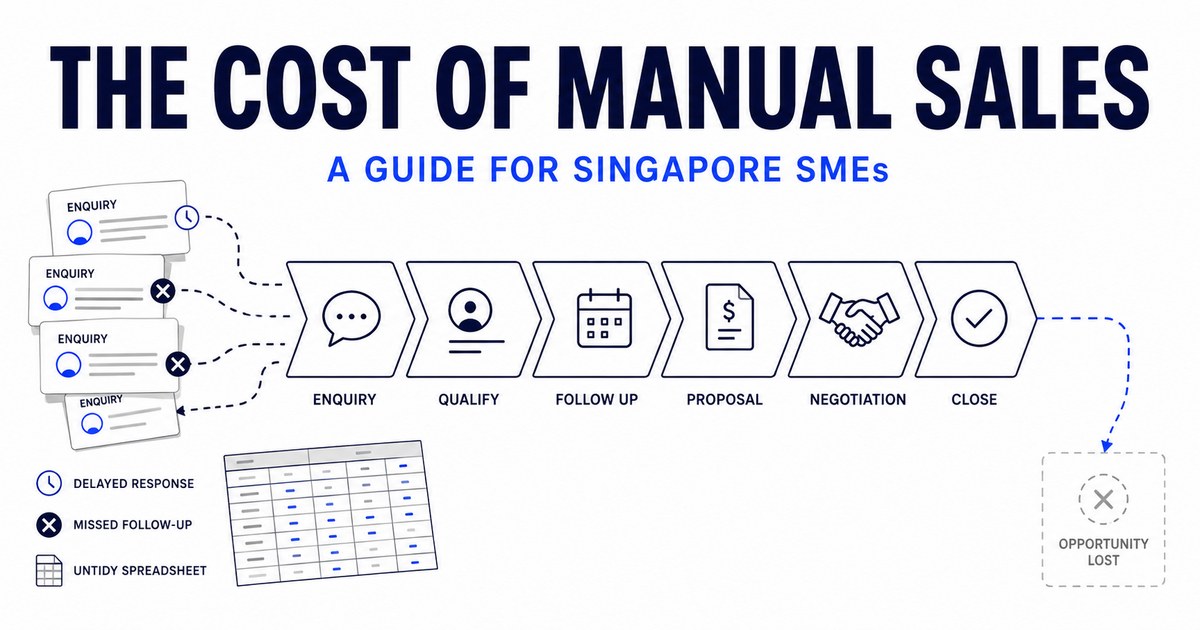
A salesperson spends 20 minutes researching a prospect. Someone copies an enquiry into a spreadsheet. A founder sends a reminder because nobody followed up. Meeting notes sit in a notebook until someone has time to update the CRM.
There is no invoice labelled manual sales process. The cost appears elsewhere, through slower responses, missed opportunities, inconsistent follow-up and expensive employees spending their time on administration.
Manual work is not always bad
Some parts of sales should remain personal. Understanding what a customer really needs, managing objections, negotiating terms and building trust all require human judgement.
The problem is not that people are involved. The problem is that people are being used for work that follows the same pattern every time, such as:
- Moving information between systems
- Researching basic company information
- Assigning enquiries
- Scheduling meetings
- Preparing standard meeting briefs
- Recording notes
- Sending routine reminders
- Checking which leads have not received a response
1. Slow responses cost opportunities
A new enquiry arrives while the team is in a meeting. Nobody notices it until the end of the day. By then, the prospect may have contacted three other providers.
The business may still respond, but it has lost the advantage of being first. It is now joining an existing comparison instead of beginning the conversation. Speed matters most when the prospect has a clear and immediate need.
Automation can acknowledge the enquiry, answer basic questions, collect missing information and alert the right salesperson. A person can then take over with the context already prepared. Sometimes a fast and useful acknowledgement is enough.
2. Salespeople spend less time selling
Salespeople are usually one of the more expensive parts of a company. Despite this, many businesses use them for work that could be handled by a simple workflow: searching for company information, copying contact details into a spreadsheet, reformatting meeting notes, arranging appointment times, writing similar follow-up emails and updating several systems with the same information.
An hour spent on this work is an hour not spent speaking to customers or improving an important proposal. Hiring another salesperson will not necessarily fix the issue. If the underlying process remains manual, the company may simply create more administration.
3. Follow-up depends on memory
Most sales opportunities do not close after one conversation. Someone needs to send additional information, answer a question, check in after a proposal or reconnect when the prospect is ready.
When follow-up depends on individual memory, it becomes inconsistent. This creates two risks. The first is that good opportunities are forgotten. The second is that the company does not actually own its sales process. Each salesperson does.
A structured follow-up workflow can track the next action, remind the responsible person and prepare a suitable message using the context of the previous conversation.
4. Lead quality is judged inconsistently
Ask three salespeople what makes a lead valuable and you may receive three different answers. One may focus on company size. Another may focus on urgency. A third may prioritise anyone who replies quickly.
Human judgement still matters, but inconsistent qualification makes it difficult to allocate the team's attention. A simple prioritisation process can assess each enquiry against agreed factors such as:
- Business need
- Company profile
- Budget
- Location
- Purchase timeline
- Decision-making authority
- Fit with the company's services
AI can organise the information and recommend a priority. The salesperson remains responsible for deciding how to proceed. The benefit is not perfect scoring. It is having a consistent starting point.
5. Customer information becomes scattered
A typical business may have customer information across email, WhatsApp, spreadsheets, personal notes, calendar invitations, a CRM and individual employees' memories. Each tool may contain part of the story.
Before a customer meeting, someone has to search through these places to understand what has already happened. If the salesperson leaves the company, part of that context may leave with them. It also creates an unpleasant customer experience, because the customer repeats information one employee cannot see.
Automation can capture key information after each interaction and place it in a shared record. A person should still review important notes, but the process no longer needs to begin from scratch every time.
6. The founder becomes the sales system
In many smaller companies, the founder knows every customer and opportunity. Employees ask the founder whether a lead is worth pursuing, what to send, who should follow up and what was promised last time.
This works when the company is small. It becomes a bottleneck as sales activity increases. The founder spends more time coordinating work and less time making decisions that genuinely require their attention.
A good sales system captures how the founder thinks about common situations. It gives the team clear rules, useful information and defined escalation points. The objective is not to remove the founder from sales. It is to stop involving the founder in every routine step.
7. Reporting becomes unreliable
A company cannot manage its sales pipeline properly when the underlying information is incomplete. If follow-ups are not recorded and opportunities are not updated, the CRM becomes a rough estimate rather than a management tool.
This affects decisions about hiring, marketing spending, revenue forecasts, cash flow, which services to promote and which customer segments to pursue. Automation can remind salespeople to update important fields or capture information from approved sources, which improves the quality of the pipeline data.
8. More leads create more problems
Businesses often focus on generating more leads. That makes sense when demand is low. But if the sales process is already struggling, additional leads may make the situation worse: longer response times, more administrative work, more inconsistent follow-up and more opportunities that disappear without explanation.
Before spending heavily on lead generation, check whether the existing process can manage a higher volume. There is little value in filling a bucket that is already leaking.
How to estimate the cost of your manual process
You do not need a complex model. For one week, ask the sales team to record how much time they spend on repetitive activities such as research, scheduling, data entry, meeting preparation and follow-up administration. Then consider three questions:
- What does this time cost the company?
- What customer-facing work was delayed?
- How many leads did not receive the correct follow-up?
The salary cost is only one part of the answer. The larger cost may come from the opportunities the team never progressed.
What should you automate first?
Start with work that is frequent, repetitive and easy to review. Good first candidates include:
- Routing new enquiries
- Preparing meeting briefs
- Scheduling appointments
- Recording call summaries
- Drafting follow-up messages
- Reminding salespeople about overdue actions
- Reconnecting with old prospects
Avoid starting with a large system that tries to automate the entire sales process. A focused workflow is easier to test, measure and improve.
The risk of waiting
AI adoption among Singapore SMEs increased from 4.2% in 2023 to 14.5% in 2024, according to IMDA's Singapore Digital Economy Report.
This does not mean every company needs to rush into a large AI project. It does mean manual processes are increasingly being compared with competitors that respond faster, operate with better information and handle more activity without adding the same amount of administrative work.
The risk is not that AI will suddenly replace your sales team. The more realistic risk is that another sales team uses it to become easier to buy from.
SimplePlainAI builds practical AI agents for sales and operations teams. Explore our AI agents for sales and operations, or tell us which task is slowing your team down.
Book a discovery call