
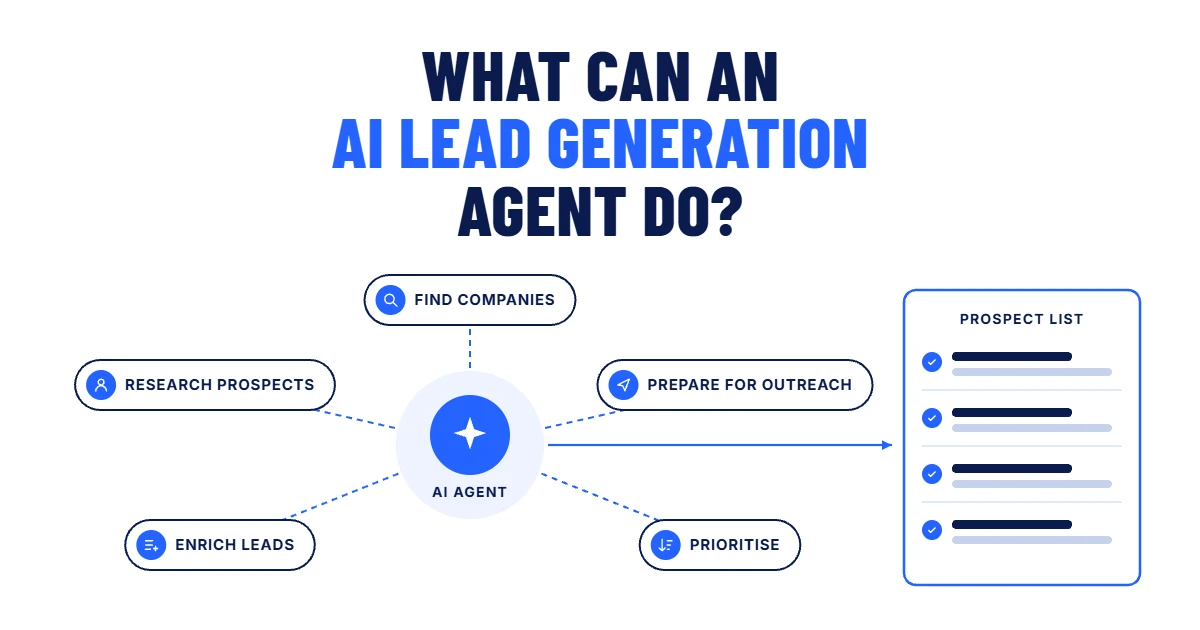
That can include finding companies, collecting relevant information, enriching lead records, applying simple qualification criteria, and organising the results for review.
What is an AI lead generation agent?
An AI lead generation agent is a system designed to perform defined prospecting tasks. The business provides the target customer criteria and the agent follows a repeatable process to find or research potential prospects.
A useful agent has clear boundaries. It should know what information to collect, where it can look, how results should be structured, and where a salesperson needs to review the output.
1. Find companies that match your target customer
If your sales team already has a clear ideal customer profile, an agent can use those criteria to help identify potential companies. Criteria might include industry, geography, company size, market, business type, or other characteristics that matter to your sales process.
2. Research each company
The agent can collect the information your team normally looks up manually before outreach. The exact fields depend on the business. The value comes from making the research consistent and reducing repeated browsing.
3. Enrich existing leads
If you already have a list of companies or contacts, an agent can help add available business information to the records. This can reduce the time spent preparing a list before the sales team starts outreach.
4. Apply qualification criteria
An agent can compare prospects against criteria your team defines. This does not mean the system should make every sales decision. It can provide a first pass that helps a person decide where to spend time.
5. Prepare information for outreach
Instead of giving a salesperson a company name and asking them to start from scratch, the workflow can prepare a concise prospect summary. The salesperson can then review the information and decide whether and how to make contact.
What should stay human?
Salespeople should remain involved where judgement, relationship building, negotiation, or context matters. The agent can do the repetitive preparation while the salesperson decides who is worth pursuing and how to approach them.
Example workflow
- Sales team defines target customer criteria.
- Agent finds potential companies.
- Agent researches the agreed fields.
- Agent enriches and structures the lead record.
- Salesperson reviews the result.
- Approved prospects move into outreach or the existing sales workflow.
When does an AI lead generation agent make sense?
It is most useful when your team repeats the same prospecting research, has clear criteria for a good prospect, and spends enough time on the task for automation to matter. If the target market is tiny or every prospect requires completely different research, automation may add less value.
If prospect research is taking up too much of your team's time, see how SimplePlainAI approaches AI Lead Generation for Singapore Businesses
Related guide: How to Automate Lead Generation Without Automating Your Entire Sales Process
Book a discovery call