
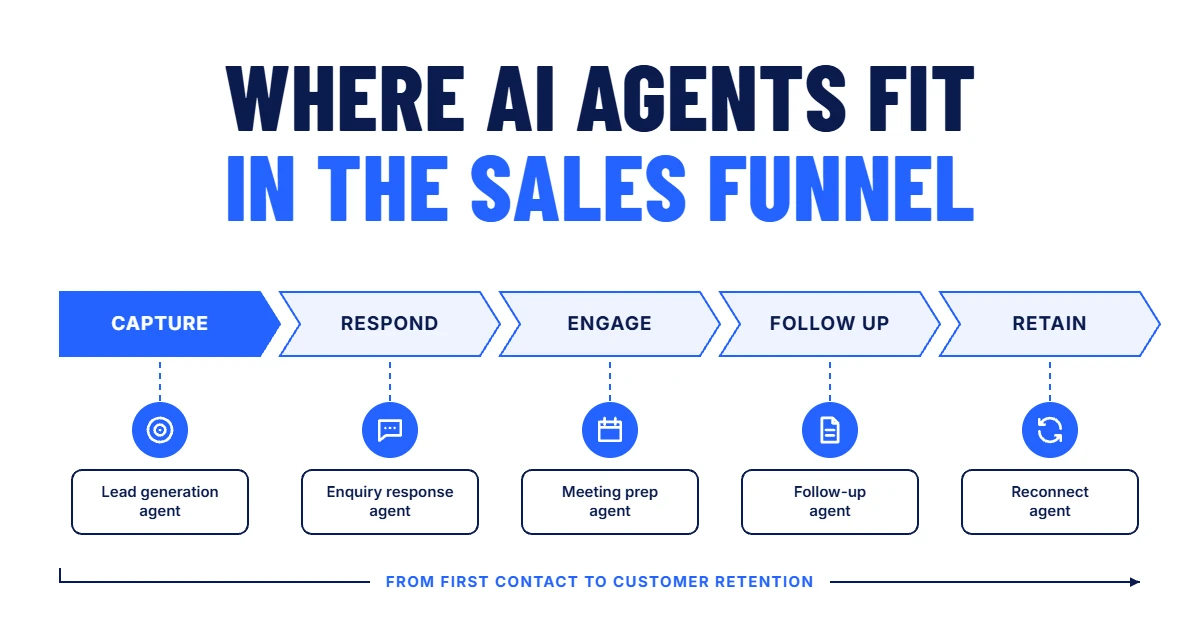
SimplePlainAI uses five stages to organise these workflows: Capture, Respond, Engage, Follow up, and Retain.
1. Capture: find and research potential customers
Before a conversation begins, sales teams need prospects. AI agents can support prospect discovery, lead research, enrichment, and initial prioritisation. The objective is to reduce the manual work required to prepare a useful prospect list.
Related service: AI Lead Generation Singapore
2. Respond: handle the moment an enquiry arrives
Inbound leads often arrive with incomplete information or repetitive questions. An agent can respond to selected enquiries, collect missing details, and prepare the conversation for a salesperson.
Related service: AI Customer Service Automation Singapore
3. Engage: support the active sales conversation
Once a real sales conversation begins, AI can support preparation rather than replace the salesperson. A meeting preparation workflow can research the company, organise relevant information, and give the salesperson a concise briefing before the call.
4. Follow up: keep opportunities moving
Follow-up work is easy to delay because it competes with new conversations. AI can support defined workflows such as preparing follow-up drafts, summarising next steps, or drafting proposal material for review.
5. Retain: support the work after the sale
The customer journey continues after a deal closes. Defined onboarding, reconnection, and renewal workflows can help teams keep track of actions that otherwise rely on manual reminders.
You do not need an agent at every stage
A business should not automate a stage simply because it can. Start where repetitive work is creating a real bottleneck. Solve that workflow first, keep human review where judgement is required, and expand only if the result is useful.
How to choose the first workflow
- It happens frequently.
- It consumes meaningful time.
- The steps are reasonably consistent.
- The required information can be identified.
- The output can be reviewed.
- There is a clear rule for when a person takes over.
If most of those conditions are true, the workflow is worth examining.
Explore the full SimplePlainAI sales-agent framework: AI Agents for Sales Teams
Related guide: 7 Sales Tasks You Can Automate With AI
Book a discovery call